
El Paso Release Destinations
An El Paso County detention entry tied to a Hudspeth matter normally begins with a transfer. Hudspeth County may send a person because of another warrant, a court order, available contract space, or a receiving agency's authority. The first local movement sheet should identify the destination and date. Once El Paso accepts custody, its record becomes the source for a later release from that system. Those two records describe two separate events.
A later El Paso County release may return the person to the community after bond, dismissal, time served, sentence completion, or another valid order. It may also lead to TDCJ, USMS, ICE, or another county. The receiving record must be read before choosing the next locator. The Hudspeth County release search and record path explains how the original movement entry and court order fit together.
| Recorded event | Meaning | Next source |
|---|---|---|
| Hudspeth transfer to El Paso | Local booking ended; custody continued | Hudspeth movement sheet and El Paso custody system |
| El Paso community release | Person left county detention | El Paso release record and controlling court order |
| El Paso transfer to TDCJ | State custody began | TDCJ offender search |
| Federal or ICE handoff | Another authority took custody | USMS, BOP, federal docket, or ICE ODLS |
Confirm El Paso Release Status
Start with stable identifiers. A full legal name, date of birth, Hudspeth booking number, El Paso booking number, and court case number help separate people with similar names. Ask Hudspeth County Jail whether the event was a transfer and obtain the exact receiving agency. Then check the receiving county's official custody channel. A record that no longer appears in a live custody view still needs a movement or release record.
- Confirm the Hudspeth movement destination and transfer date with the sheriff at (915) 369-2161.
- Use the receiving agency's official custody system with the person's name and birth date or assigned number.
- Ask whether the El Paso booking remains active, ended in community release, or ended in another transfer.
- Match the physical movement to the signed order in the correct Hudspeth, El Paso, or federal court file.
- Request the receiving county's existing release or movement record when the live view cannot answer the history question.
Who Owns El Paso Records
The agency holding the person at each stage owns the related custody record. Hudspeth County controls its booking and outbound movement sheet. El Paso County controls the receiving booking and its later release entry. A court clerk controls signed judicial orders. TDCJ, USMS, BOP, and ICE each keep records for their own custody systems. Sending one broad request to Hudspeth will not produce a record that El Paso or a federal agency created.
- Movement record
- The jail entry showing when a person left one facility and where the person was sent.
- Release record
- The receiving jail's entry showing the date, reason, authority, and destination when its booking ended.
- Disposition
- The court's formal outcome or signed order; it does not by itself prove the exact time of physical release.
- Detainer
- A request or legal basis for another authority to take or continue custody after one booking ends.
Request the records in sequence. This keeps a transfer from being mislabeled and helps reveal an unrelated hold that survived a bond or dismissal in the Hudspeth case.
Hudspeth Transfer Contact Route
The initial handoff must be confirmed with the Hudspeth County Sheriff's Office. The office publishes the contact below. Its two official web pages give different street descriptions, so mailed requests should use the P.O. box and any visit or courier delivery should be confirmed by telephone.
Hudspeth County Sheriff's OfficeP.O. Box 39
Sierra Blanca, TX 79851
Phone: (915) 369-2161
Fax: (915) 369-2126
Email: sheriff@hudspethsheriff.org
Monday through Friday, 8:00 a.m. to 5:00 p.m.
Ask for the outbound movement date, receiving agency, destination, and any recorded receiving identifier. Do not ask Hudspeth staff to certify what happened after another county accepted the person. That later event belongs to the receiving record custodian.
Request El Paso Release Records
A focused request should identify the receiving booking rather than ask an office to research a story. State the full legal name, known aliases, birth date, approximate transfer date, and both county booking numbers when known. Ask for existing booking, movement, and release entries, including the release date and time, release type, legal authority, and destination if those fields are maintained and releasable.
Texas Government Code sections 552.021 and 552.221 govern access to existing public information and prompt production, subject to exceptions. Prompt does not mean that every request must be delivered within ten business days. Active law-enforcement matters, confidential identifiers, juvenile records, security information, and sealed or expunged material can cause redaction or withholding. If a cost estimate applies, request it before copies are made.
When the receiving agency reports no record, verify the spelling, birth date, date range, and agency name. A person sent to a USMS contract bed in the El Paso region may be held under federal authority rather than booked as an El Paso County detainee. The federal route then matters more than the county search.
Keep copies of each response and note the date it was obtained. A current custody screen can change after another movement, while the requested record preserves the event tied to the specified booking. If the office redirects the request, ask which agency accepted custody and whether an identifying number was recorded. That narrow follow-up can prevent repeated searches in the wrong county system.
El Paso Federal Release Route
Hudspeth County lies in the Western District of Texas, El Paso Division. A case arising at the Sierra Blanca checkpoint or through other federal enforcement may enter that court even though the arrest took place in Hudspeth County. The El Paso federal court location is a case and disposition source. It is not a jail locator.
USMS controls many pretrial movements and may use contract detention beds. Those detainees may never appear in the BOP Inmate Locator. After a federal sentence and BOP designation, the national locator becomes useful. A former federal prisoner result may state “Released,” show a date, or indicate that the person is not in BOP custody. None of those results resolves a separate Hudspeth or El Paso County hold.
For agency movement records, use the USMS Freedom of Information Act route. For court history, obtain the docket and signed order. Privacy and law-enforcement exemptions can limit the response.
A federal docket can show the charge, hearings, judgment, and court orders, but it does not always show each physical move between contract beds. Pair the docket with the USMS response and the sending jail's movement entry. If the federal matter closed yet the person remained confined, check for an immigration transfer, state commitment, or another county warrant. One closed case cannot prove that all legal holds ended.
El Paso Release or Detainer
Border-region custody can move between county, federal, and civil immigration systems in a short span. A county release field may identify ICE or USMS as the destination. That wording closes the county booking, but the person remains confined under a different authority. Check the named receiving system before describing the event as a return to the community.
The ICE Online Detainee Locator System checks current civil immigration custody by A-number and country of birth or by biographical information. A missing result is not proof of release. Recent processing, transfer, removal, identity mismatch, release under supervision, or a category the locator does not display can all produce no result. The local movement record remains the bridge between systems.
El Paso Supervision After Release
The TDCJ parole county cross-reference is the official source captured for this facility page.
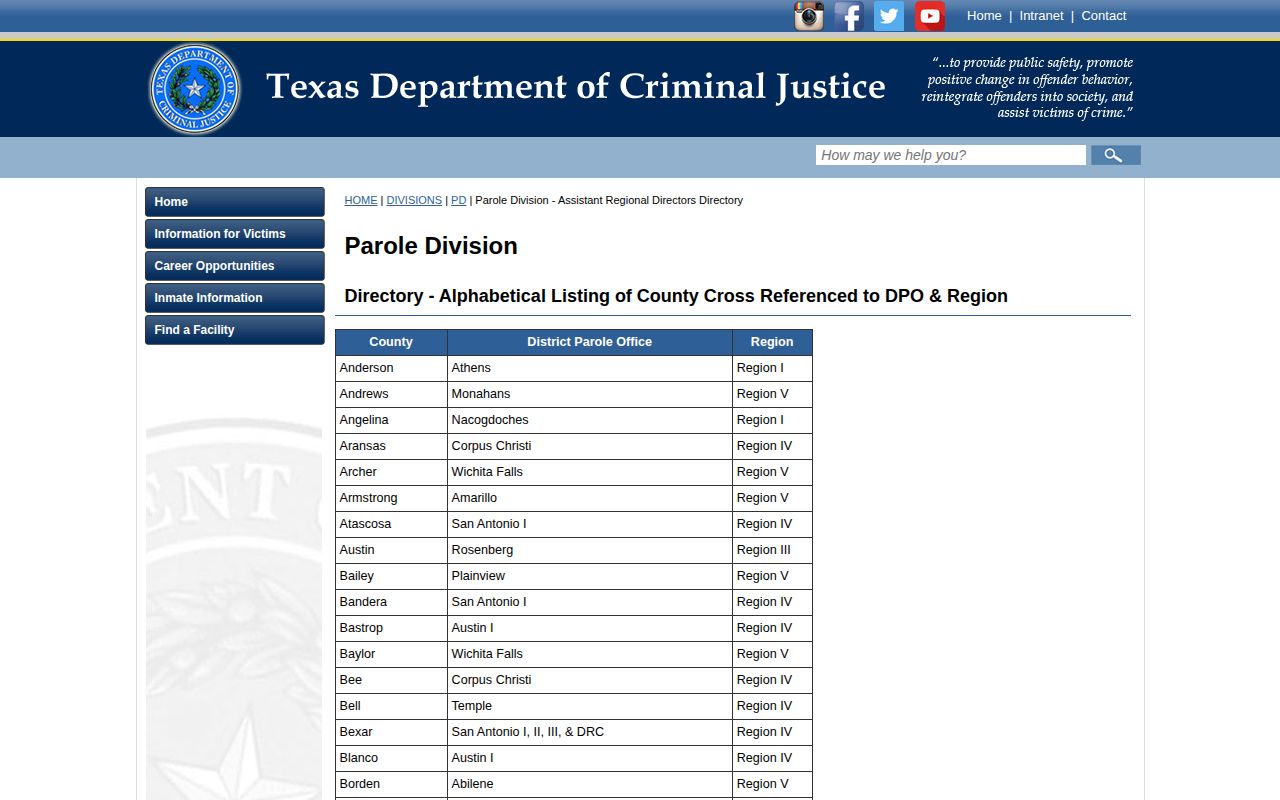
The image shows why release supervision is routed by county and agency, not simply by the jail building from which a person left.
Parole is supervised release from a TDCJ sentence. It differs from county probation, which follows a court's community-supervision order. If an El Paso movement leads into TDCJ, search the person in the state offender system and use the assigned parole route after release. The county jail cannot confirm current TDCJ supervision.
Use the TDCJ or SID number when available. A scheduled state release location may differ from the unit where the person was confined, and supervision may be assigned in a different county. The cross-reference identifies the office route for a county, not the location of every released person. Confirm the individual assignment through TDCJ before relying on an office address.